
Finding Homestead Residents by Record
Choose the first source by what you know. An address belongs in the Miami-Dade County Property Appraiser search. A person's role in a lawsuit belongs in the Clerk's court systems. A business name belongs in Sunbiz. Older names and addresses often belong in the museum's directory and newspaper collections. These records do not form one complete Homestead residents directory. Each captures a dated legal or civic link.
Keep the date, spelling, address, and role from every result. Then confirm at least one of those points in a second official source. An owner may not live at the parcel, a registered agent may not run a business day to day, and a court party may have left Homestead long ago.
A phone number or old street name needs the same care. Homestead's early telephone lists used shared rural lines and ring patterns, while modern county systems normalize addresses for parcels and mail. Search a surname with and without accents, try initials, and inspect the scanned page when optical text misses a compound name. Homestead's large Spanish-speaking and foreign-born population makes those spelling checks practical, not optional.
- Search the county property roll by owner name or street address.
- Use a folio or legal description to connect the parcel to recorded deeds.
- Check the appropriate civil, probate, criminal, voter, or license index.
- Move to directories, newspapers, and archives when the question reaches back in time.
- Ask the correct custodian for material that has not been posted online.
Who Keeps Homestead Resident Records
Custody follows jurisdiction. Homestead City Clerk keeps municipal correspondence, council records, liens, and public requests. The Miami-Dade Property Appraiser holds the property roll. The Miami-Dade Clerk serves as recorder and court clerk, but uses separate systems for official records, civil and probate matters, and criminal cases. Elections records come through Miami-Dade Elections and the state self-lookup. That split is the key to a useful residents directory search.
Miami-Dade County Recorder
73 W. Flagler Street, Room 133
Miami, FL 33130
305-275-1155
Property Appraiser
South Dade Government Center
10710 SW 211 Street, Cutler Bay
305-375-4712
The full street-by-street method belongs in the Homestead street directory. For a first pass, these three offices explain most local address and ownership questions.
Other records branch from that core. Miami-Dade Elections handles voter-data requests. Florida Department of Health in Miami-Dade routes local vital certificates, while the state Bureau of Vital Statistics holds statewide certificates. The Town Hall Museum and Historic Homestead and South Dade preserve the strongest named historical sources. Federal court research for Homestead belongs in the Southern District of Florida and PACER, not in the county court search.
Homestead Property Search Modes
The Property Appraiser provides the most direct path from a Homestead name or address to a parcel. Its search modes accept an address, owner name, folio, or subdivision. Results can show the situs address, owner and mailing address, legal description, assessed values, sales, building facts, exemptions, and a parcel map. Mailing and situs addresses may differ, so neither should be treated as proof of who sleeps at the property.
| Search mode | Best starting fact | Useful result |
|---|---|---|
| Address | House number and street | Parcel and listed owner |
| Owner name | Surname or entity | Matching county parcels |
| Folio | 13-digit parcel key | Exact property card |
| Subdivision | Recorded plat name | Lots in the development |
Open the Miami-Dade Property Appraiser search guide before choosing a mode.
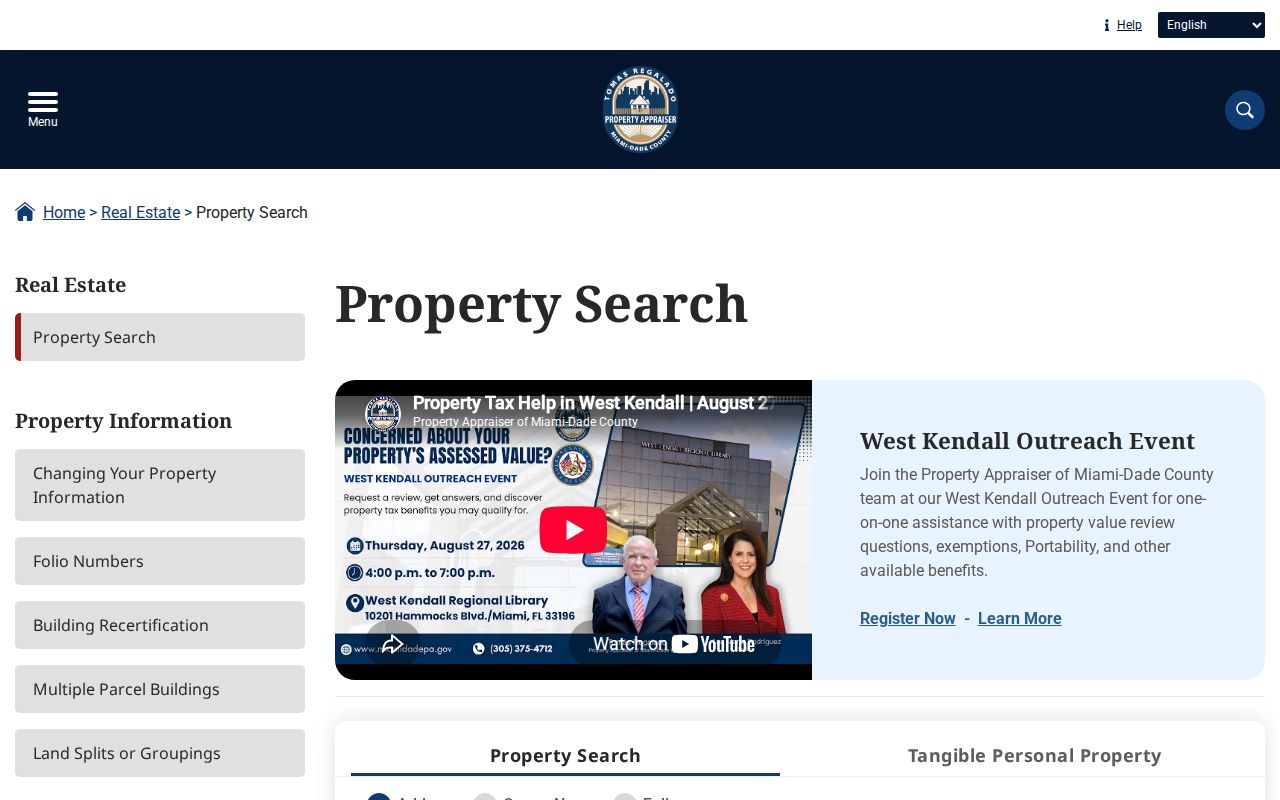
The captured page shows why an address, owner, folio, and subdivision lead to different but connected paths.
A Miami-Dade folio has 13 digits divided into municipality, township, range, section, subdivision, and parcel elements. That key is more stable than loose street text. Homestead city folios begin with municipality code 10, but a postal Homestead address outside the municipal line may use another code. Confirm the map and jurisdiction before sending a city request.
From Homestead Parcel to Deed
A property card identifies the current tax-roll relationship. The County Recorder's index adds the recorded history behind it. Search grantors and grantees, instrument numbers, recording dates, document types, and legal descriptions. Most documents are online from 1974 forward. Earlier work shifts to the Records Library, which maintains older indexes and documents and accepts in-person or mail copy requests.
The ordinary Official Records search is free. Advanced search features use $1 units. Records Library staff searches cost $2 per name for each year searched, copies cost $1 per page, and certification costs $2 per document. These are distinct services, so the cheapest path is to gather a precise name, year, folio, or legal description before asking staff to search.
The Miami-Dade Clerk records directory routes users to the correct record family.
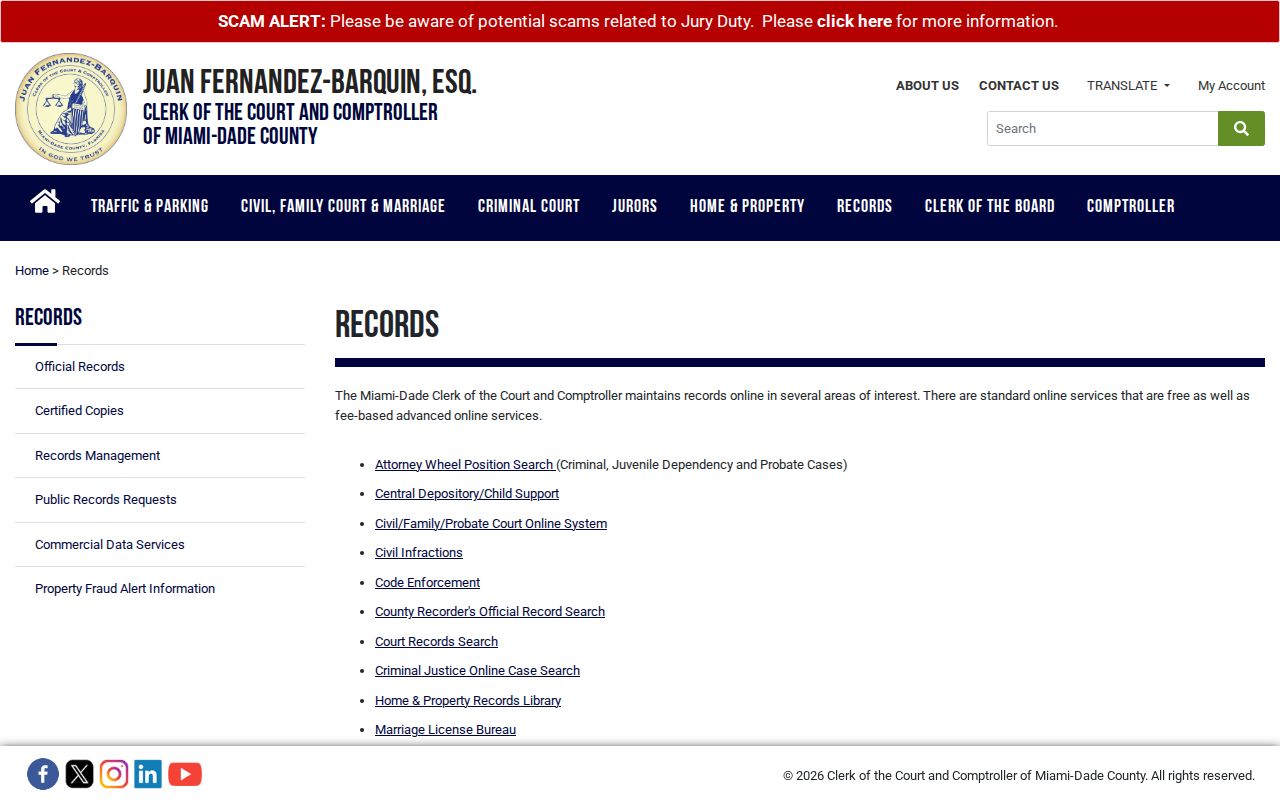
This directory matters because deeds, court cases, marriage material, and older library records do not share one search screen.
For a deed chain, begin with the current owner's acquisition instrument, note the prior grantor, and repeat backward. Keep the complete legal description because similar owner names can recur. Recorded mortgages and liens describe interests in land, not the people occupying it. The Clerk's index is strongest as a dated chain of recorded acts, not as a roll of current residents.
Present-Day Homestead Resident Rolls
Modern public systems describe roles, not a complete population. The Homestead residents directory is strongest when the source is matched to the question and its limits stay visible.
| Official source | Relationship shown | Custodian | Access route |
|---|---|---|---|
| Property roll | Parcel owner and mailing contact | Property Appraiser | Free search |
| Official Records | Parties to deeds, liens, mortgages, plats | County Recorder | Online, library, mail |
| Voter information | Registration and precinct for the voter | Elections offices | Identity-gated lookup or data request |
| City staff directory | Public city contacts | City of Homestead | Free directory |
| Court indexes | Named parties and case events | Miami-Dade Clerk | Separate civil and criminal systems |
The Homestead staff directory can be searched by category, first name, and last name.
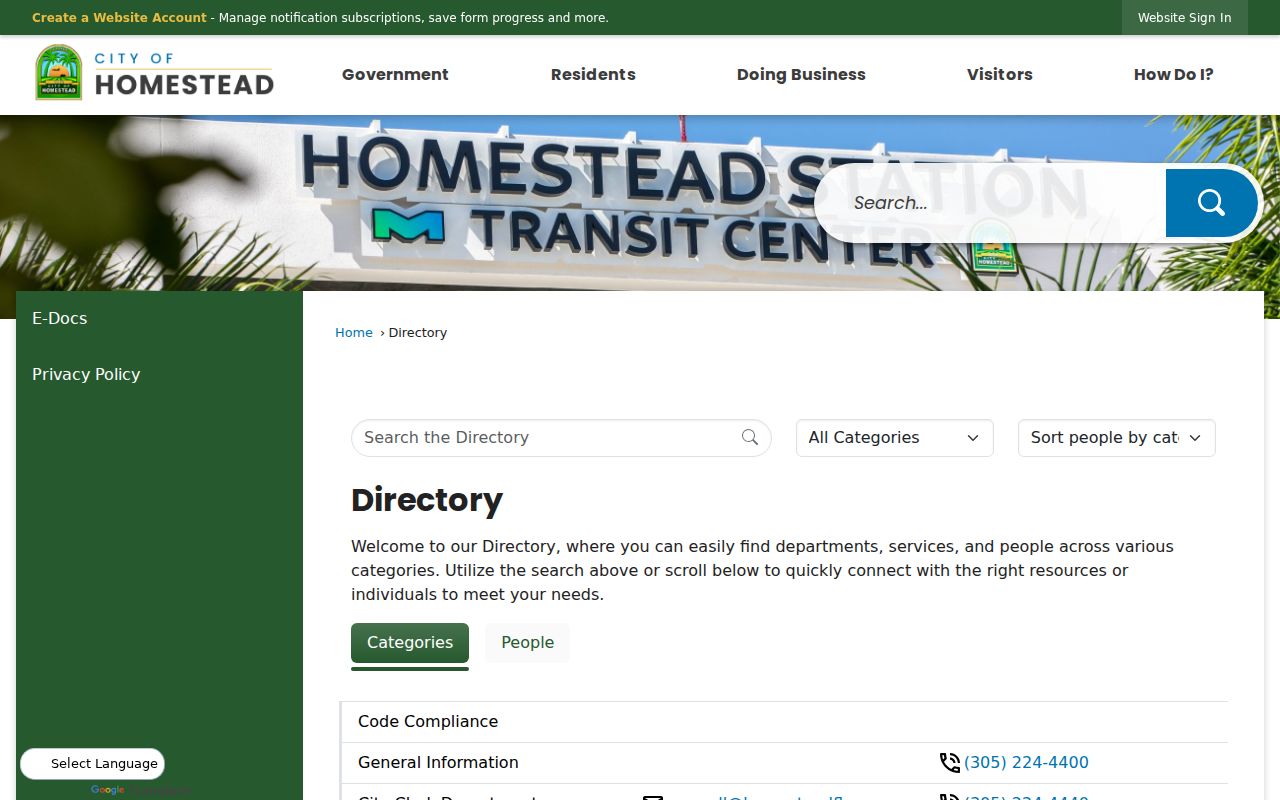
That screen identifies public-facing municipal contacts, not all people who live in Homestead.
Voter Records for Homestead Residents
Florida's voter-status page is built for a voter checking personal information. It asks for first name, last name, date of birth, and county. The result may confirm registration status and election details, but it is not a public browse-by-name or browse-by-street directory. Miami-Dade Elections handles requests for voter and archived-voter data through a separate records process.
Protected data and address exemptions matter. Florida law shields specified information under sections 97.0585 and 119.071, and qualifying people may use the Attorney General's Address Confidentiality Program. Voting history indicates participation, never how someone voted.
See the Florida voter-status lookup for the self-check fields.
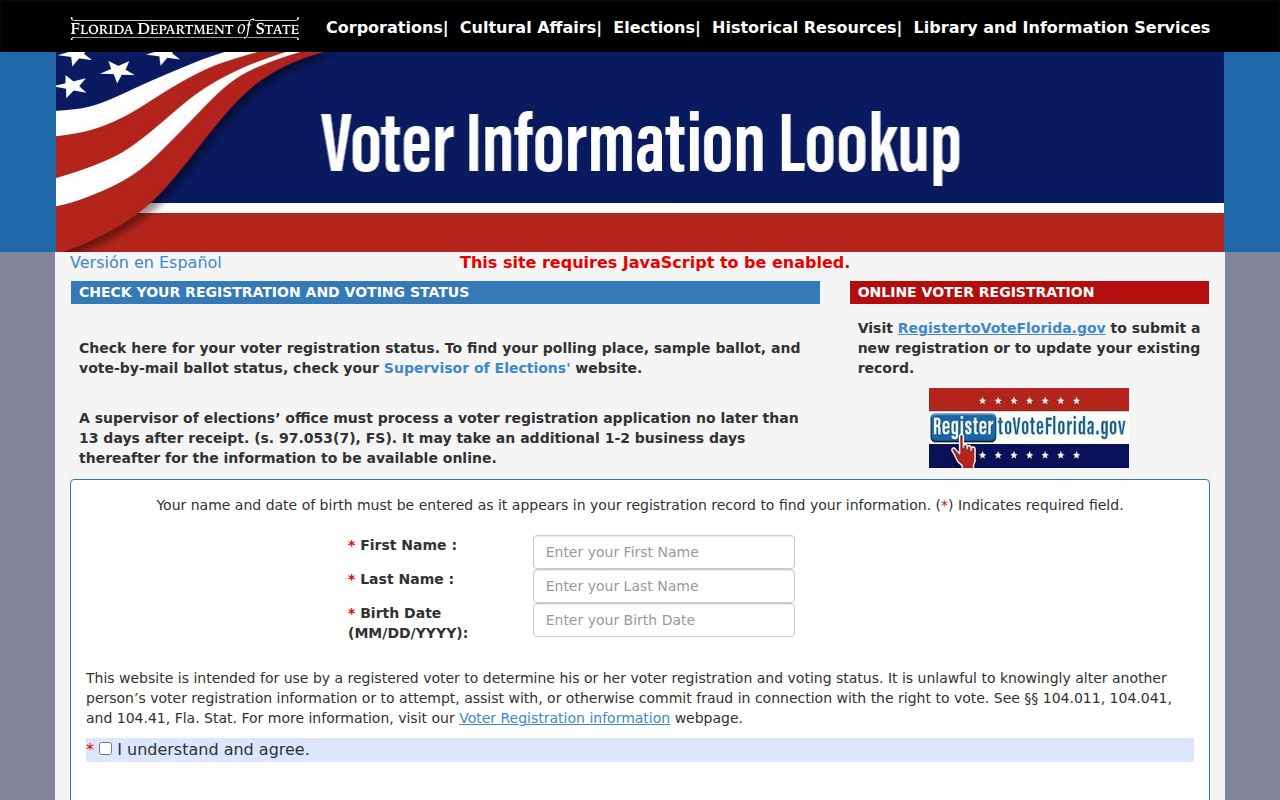
The identity fields on the form show why it cannot serve as an open residents directory.
A public voter-data request is a different process. Miami-Dade Elections accepts election-record and voter-data requests and may quote a charge when a request needs extensive resources. Archived-voter material also goes through that office. Ask for only the fields and date range needed, then apply the statutory exemptions the county identifies.
Homestead City Records on Request
Municipal records often fill gaps that county portals cannot. Homestead accepts a public-record request through JustFOIA, by phone at 305-224-4434, by email at cityrecords@homesteadfl.gov, or at the City Clerk counter. A request does not need a stated reason or a mandatory form. A clear department, address, date range, permit number, or subject helps staff find the right file.
Building and code material may show permit applicants, contractors, inspection dates, certificates, complaints, notices, magistrate cases, and liens. Those roles should not be confused with occupants. Police records use a separate channel through Homestead Police Records at 45 NW 1 Avenue, phone 305-224-5545, or RecordsRequest@homesteadpolice.com.
The city launched JustFOIA in 2024 for online submission, status tracking, payment when required, and digital delivery. It is an active channel: a city report counted 226 portal requests in one month, split between Police and Clerk work. The phone, email, and counter routes remain useful when a request needs discussion or the portal category is unclear.
The City public-record request page lists each submission route.
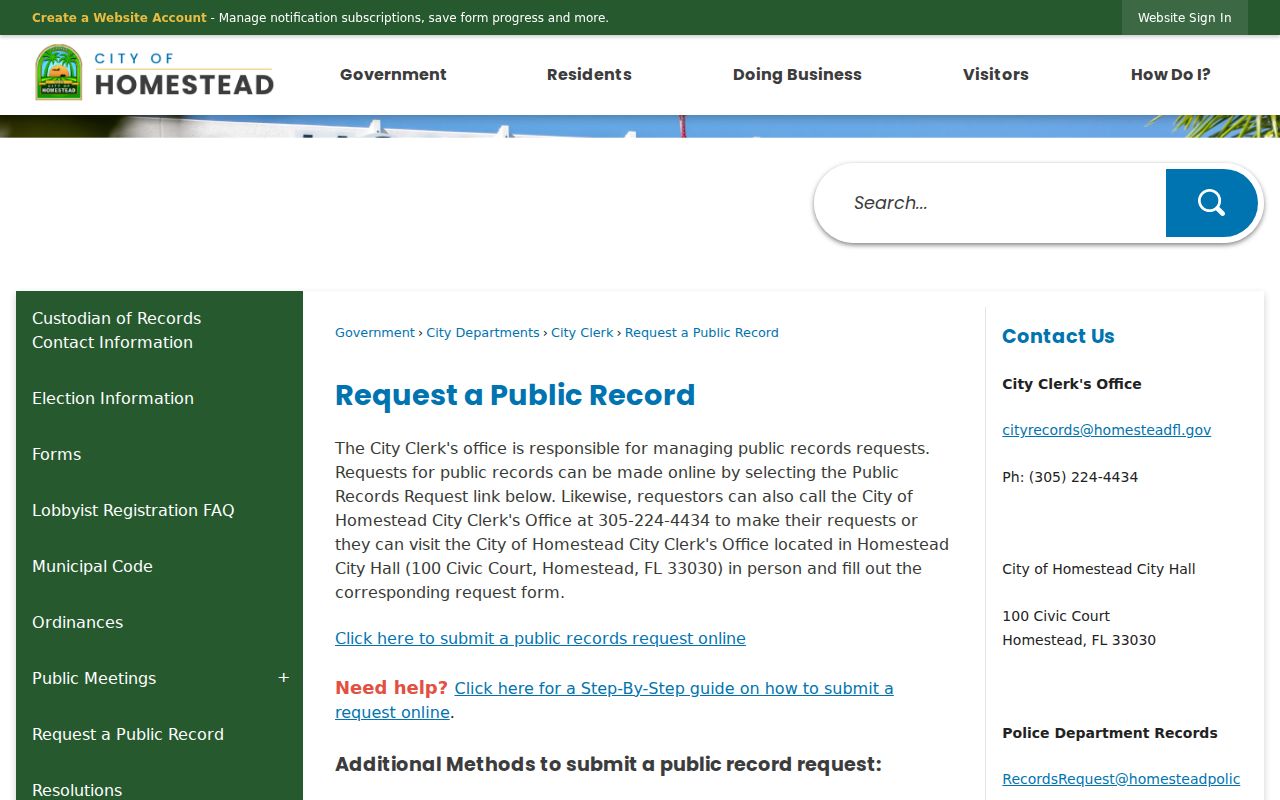
The page keeps phone, email, and counter access available when the online portal is not the best fit.
Homestead Court Name Checks
The Miami-Dade Clerk separates civil, family, and probate searching from the criminal case system. A civil or probate search can return a case number, style, filing date, status, party role, attorneys, docket entries, and available images. The criminal interface uses defendant-name and case-number routes and can show charges, events, and disposition information when public.
Names alone are weak proof. Compare middle names, filing dates, party roles, addresses when displayed, and the related parcel or business record. Sealed, expunged, confidential, juvenile, and protected filings will not become public merely because a broad residents directory search found a similar name.
Registration for the civil, family, and probate system can reduce CAPTCHA and search limits, but public access still follows the court access matrix. A docket entry may be visible when its image is not. Ask the Clerk about copies rather than assuming a missing image means the case does not exist.
- Docket
- The dated list of filings and events in a case.
- Index
- A searchable description that may not include the document image.
- Certified copy
- An official copy authenticated by the custodian.
- Parcel
- A mapped unit of land identified by a folio and legal description.
Homestead Certificates and Family Links
Vital certificates follow state access rules. Florida births less than 125 years old are confidential under section 382.025. Death certificates without cause are public, while cause-of-death and medical information remain restricted for 50 years and require eligible status. Florida Department of Health certifications cover marriages and dissolutions after June 6, 1927; the Clerk remains important for marriage licenses and older marriage material.
Application forms request event facts, the applicant's identity and relationship, mailing details, and identification where required. A certificate is not the same as a court file. For adoptees and qualifying birth relatives, Florida's Adoption Reunion Registry offers a consent-based route when adoption records remain sealed.
The Miami-Dade vital certificates page explains local and state ordering paths.
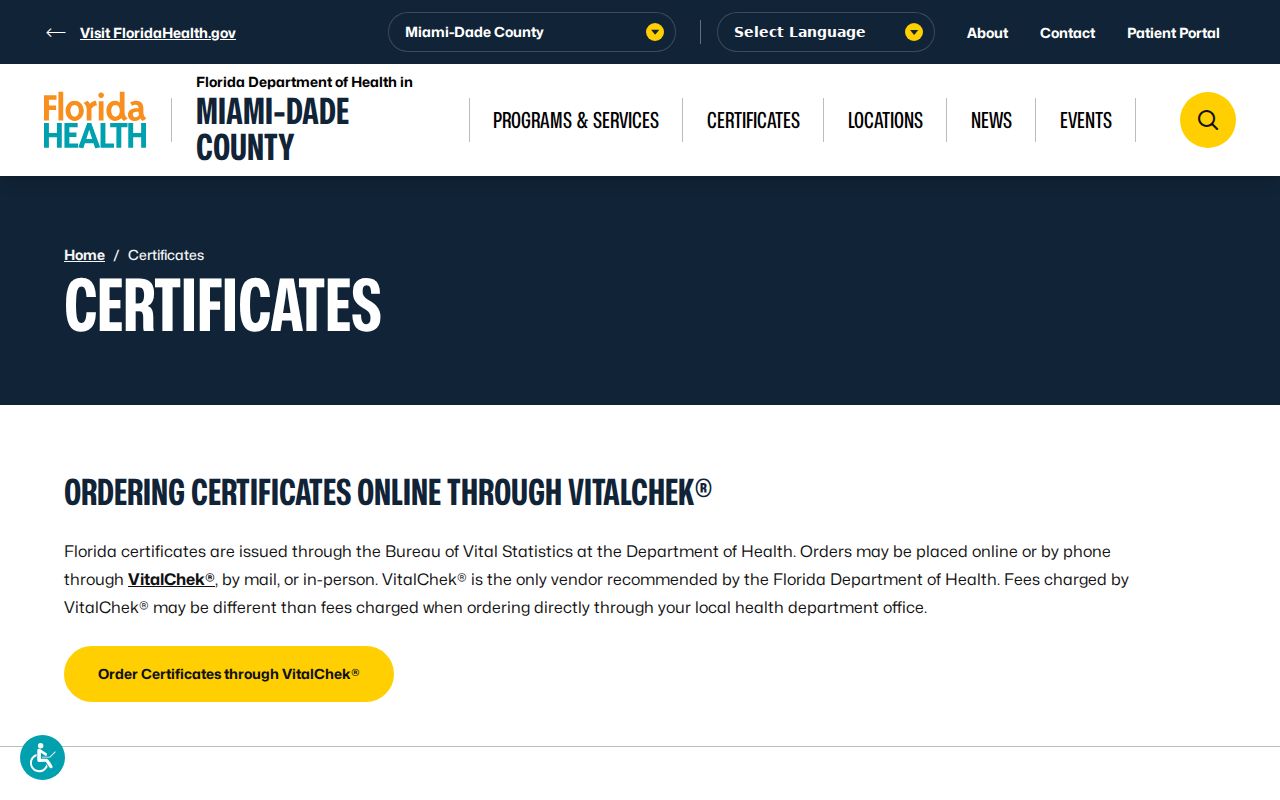
The certificate menu helps separate a birth, death, marriage, or dissolution request before forms and proof are prepared.
Local availability also changes by event and date. The Miami-Dade health office states that Florida births are locally available from 1930 and statewide deaths from 2009. The state bureau is the broader fallback. For marriage before the state certification start date, use the County Clerk and its older-record channels.
Homestead Safety Record Boundaries
Custody and registry searches answer narrow public-safety questions. Miami-Dade Corrections publishes an in-custody search. Florida's Department of Corrections maintains a statewide offender search, and FDLE provides name and geographic searches for the sexual offender and predator registry. A current custody listing is not a full criminal history, and a name match still requires identifiers.
Use the Miami-Dade inmate search only for current county custody.
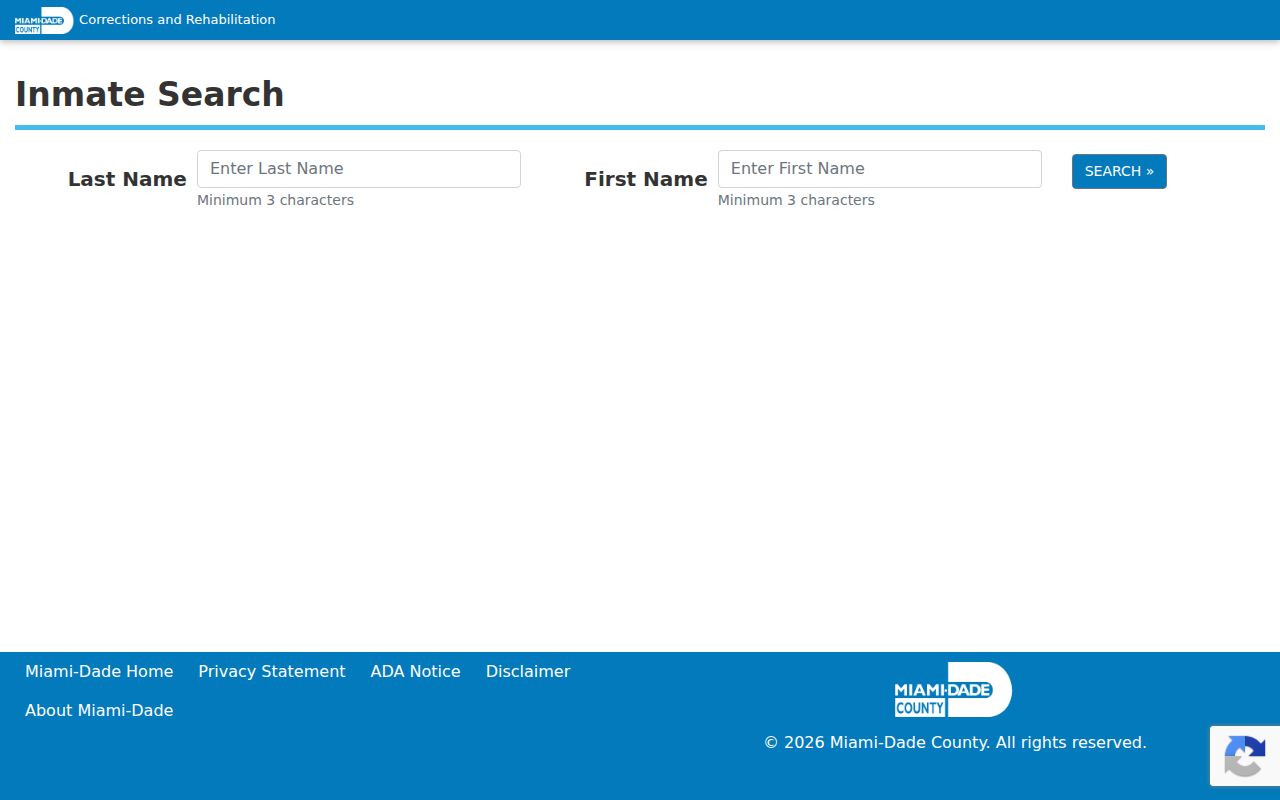
The form's limited purpose keeps a current detention result from being read as a directory entry.
FDLE also offers a registry search by name or area.
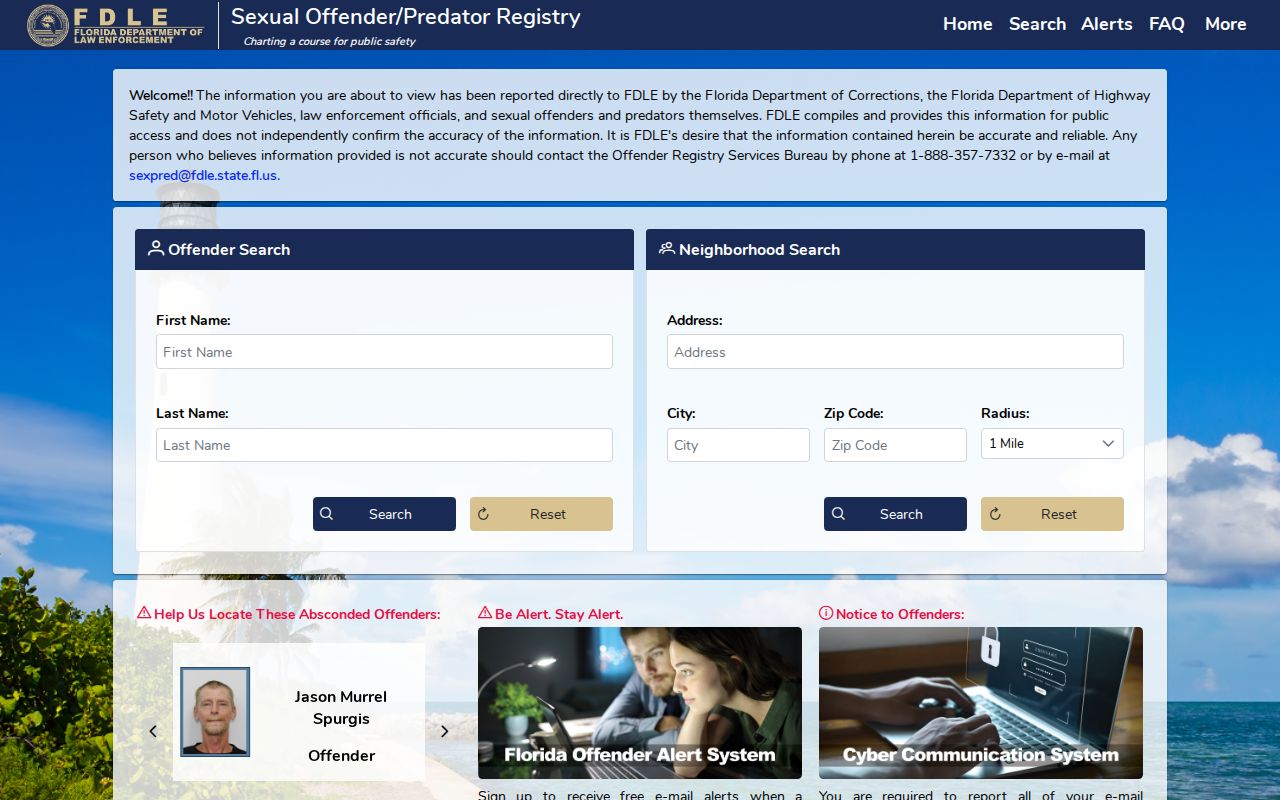
The geographic mode can aid lawful personal safety research, but it must never be used to stalk, threaten, or harass anyone.
Official Rolls Versus Search Sites
Official records are narrower than commercial search products, yet their custody, date, and legal purpose are clearer. A property card shows ownership as of a roll date. A deed index shows named parties to a recorded instrument. A court docket shows a case role. Commercial tools may merge old addresses and names without making those distinctions plain.
Official record
Named custodian, defined field set, dated role, direct correction or copy route.
Commercial category
Broad aggregation, uncertain update times, possible fees, and links that may join different people.
Start with the official source closest to the question. Use a second official source before deciding that two records concern the same Homestead resident.
Lawful use. Public access supports genealogy, civic review, reunions, estate work, fraud avoidance, and personal safety. It does not permit stalking, harassment, threats, or harm.
Homestead Resident Directory History
Homestead's historical trail is made of firm checkpoints rather than an annual shelf. R.L. Polk published a local directory in 1927 after the boom, James W. English produced the 1938 Redland District News Directory, and Polk returned in 1955. Reconstructed telephone lists survive for selected years from 1913 through 1943. The 1926 list even preserves rural party-line ring codes that should not be read as modern phone numbers.
Coverage was regional. The 1927 and 1955 Polk volumes extend from Goulds through Florida City and west into Redland, while the 1938 directory spans Benson to Tavernier. A historical entry labeled Homestead may describe the wider postal or trade area rather than today's city boundary. Pair the entry with a plat, census place, parcel description, or map.
Historic Homestead and South Dade, the Town Hall Museum, the Miami-Dade Public Library System, and the State Library of Florida provide complementary access. The full collections and entry-reading method appear in the Homestead city directories guide. Newspapers help bridge gaps: the South Florida Banner begins in 1912, Homestead Enterprise follows from 1914, and the merged Homestead Leader-Enterprise starts in 1931.
Homestead Records Changed Medium
The local record trail follows the city's growth. South Dade opened to homesteaders in 1898, the rail route was surveyed in 1902, and Homestead incorporated in 1913. Council minutes begin with incorporation. Sanborn maps document the built area in 1914, 1920, and 1927, while printed directories, phone lists, and newspapers provide names between those map dates.
Modern access has its own turning point. A grant-backed digitization project prepared historic city files for Laserfiche, and Homestead launched JustFOIA in September 2024 for submission, tracking, payment, and digital delivery. Online access did not erase older shelf and counter work. It added a new channel to a residents directory that still spans city, county, state, and archival custodians.