
Surviving Homestead Directory Collections
Homestead has an unusually clear but discontinuous set of local snapshots. Historic South Dade and the Town Hall Museum provide three district directories, a long run of telephone transcriptions, and links to newspapers and other community sources. County and state libraries supply fallbacks when the local scans are hard to read or a catalog search must extend beyond South Dade.
| Collection | Years | Where Held | Access |
|---|---|---|---|
| Homestead-Redland District Directory | 1927 | Historic South Dade / Town Hall Museum | Free OCR PDF and separate name index |
| Redland District News Directory | 1938 | Historic South Dade | Free OCR PDF |
| Directory of Homestead | 1955 | Historic South Dade | Free OCR PDF |
| Homestead telephone listings workbook | 1913, 1919, 1922, 1926, 1931, 1933, 1934-1940, 1943 | Town Hall Museum | Free transcription with provenance notes |
| Florida city-directory collection | Early 1900s-present statewide | State Library of Florida | On-site reference and catalog help |
R.L. Polk & Co. published the 1927 Homestead-Redland volume from Jacksonville. The real-estate crash prevented another Polk issue until 1955. James W. English, owner of the local Redland District News, produced the only identified directory between them in 1938. This is not a year-by-year city directory run. Absence in a missing year proves nothing.
The local telephone sequence gives more checkpoints, yet it represents subscribers rather than all households. Newspapers cover many of the same decades through notices, advertisements, obituaries, and social items. Together these records reduce the gaps, but no source becomes a complete city directory merely because it fills an empty year.
The Historic South Dade directory page gathers the local volumes and explains their publication history.
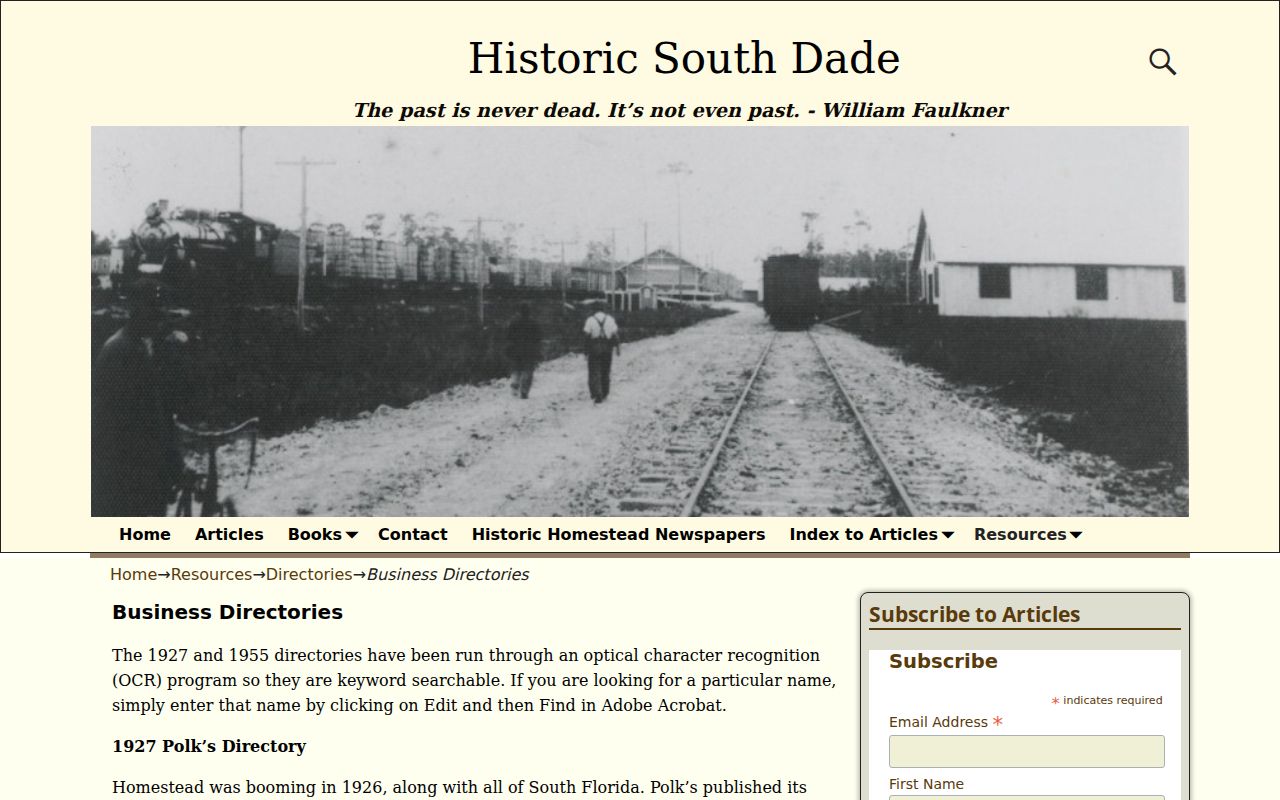
Homestead Directories Cover South Dade
The word Homestead on a cover does not confine an entry to current city limits. The 1927 and 1955 Polk volumes extend from Goulds through Homestead to Florida City and west into Redland. The 1938 directory reaches from Benson, near SW 136th Street and US 1, south to Tavernier. Compare locality, spouse, business, occupation, route, and street before deciding that two similar names identify one person.
This broad geography reflects a rail and farming district. Early entries may use rural routes, boxes, groves, packers, or agricultural businesses rather than a modern city street. A current municipal map cannot be imposed on those older labels without checking plats, census geography, and contemporaneous newspapers.
Name searching also needs care in a diverse community. Try compound surnames, initials, married names, and forms with or without accent marks. OCR may split a surname across columns or confuse worn type. Search a business and route as well as the person, then inspect adjacent entries for relatives or firms sharing the same place.
Decode a Homestead Directory Entry
A Polk line compresses identity and place into a small space. Read the volume's own abbreviation key before expanding any mark. A safe pattern is: surname, given name or initials, spouse in parentheses when supplied, occupation or employer, home notation, and street, rural route, post-office box, or locality. Business rows may add firm category, proprietor, official, address, and telephone.
| Indexed name | Surname, given name, or initials as printed |
|---|---|
| Family clue | Spouse in parentheses or widow notation when supplied |
| Work clue | Occupation, trade, firm, or employer when listed |
| Place clue | Street, residence notation, locality, rural route, or box |
| Business clue | Firm name, category, proprietor, address, or telephone |
- Criss-cross directory
- A volume or section ordered by street address rather than surname.
- Householder index
- A listing centered on the named person associated with a home, not every household member.
- Abbreviation key
- The publisher's legend for short forms such as home, resident, roomer, spouse, or widow.
Florida Memory demonstrates common Polk conventions, but apply them only after the Homestead volume confirms its own key. OCR can misread initials, accents, columns, and faded type. Save the page number and inspect neighboring lines.
Homestead Party-Line Directory Codes
Homestead's old telephone records do not read like modern phone books. The Town Hall Museum telephone-directory workbook preserves listings and explains their sources.
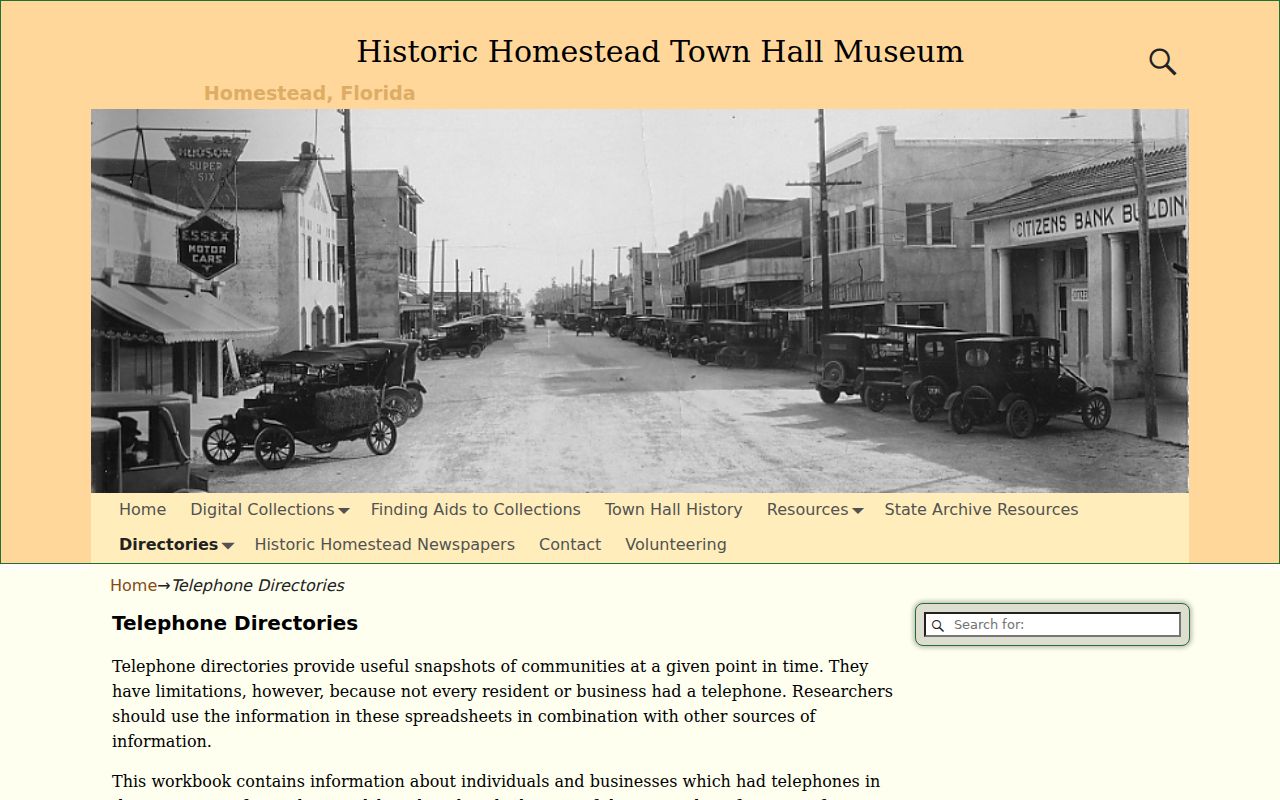
In the 1926 key, town party lines from 500 through 999 used letters for ring patterns: J meant two short rings, W three short, R four short, and M one long plus one short. Rural numbers began at 1000. Their first two digits named the line and the last two encoded the ring. Thus 2003 meant rural line 20 with three short rings. It must not be reformatted as a modern telephone number.
The museum warns that its workbook is not an exact facsimile. Jeff Blakley corrected some spellings, and older photocopies left numbers hard to read. The entries came from newspapers, telephone-company books, and Library of Congress holdings. Treat the transcription as a search aid, then cite the underlying source where possible.
Homestead Museum Directory Companions
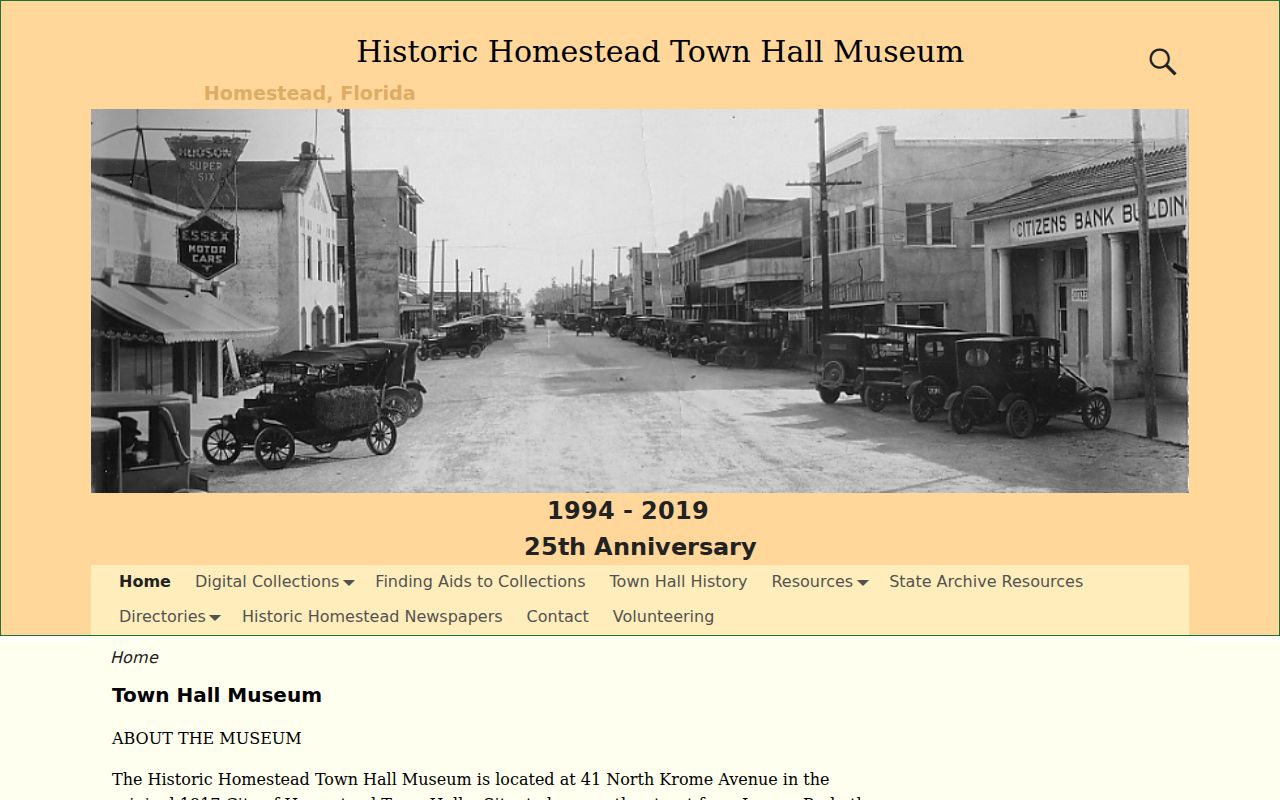
The Historic Homestead Town Hall Museum at 41 N. Krome Avenue is the most useful local research desk. Beyond city directories, its finding aids cover 1923 automobile owners, Dr. John B. Tower birth records, Naranja Cemetery and obituary indexes, township-range maps, Isabelle B. Krome papers, council minutes from 1913 through 1965, school yearbooks, church directories, and historic newspapers.
A directory hit is therefore a starting point. Cemetery data can connect a name to an obituary. Council minutes can place a person in civic activity. Township-range maps can translate a rural clue. Each source has its own date and purpose.
Homestead School and Church Directories
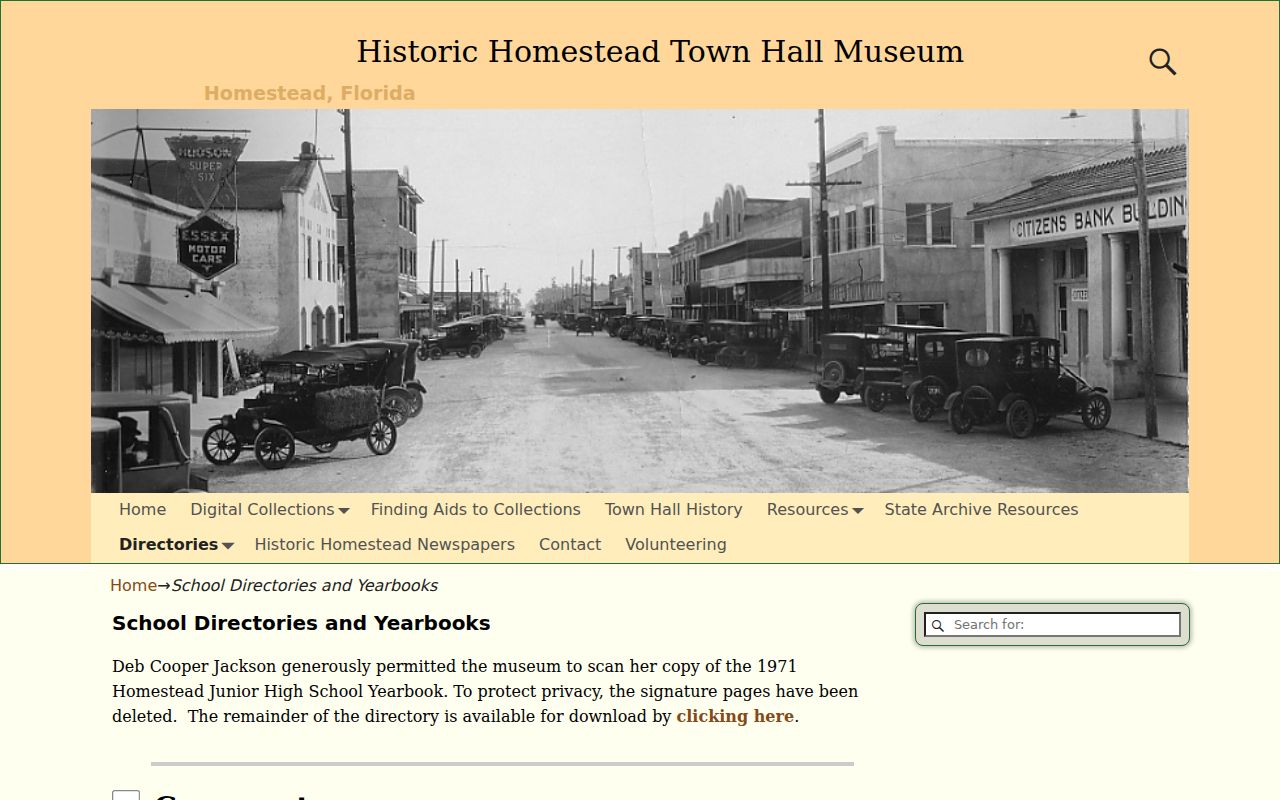
The museum offers a privacy-edited scan of the 1971 Homestead Junior High School yearbook; signature pages were removed. It also preserves an OCR-searchable 1968 First Baptist Church of Homestead directory and a church anniversary booklet. These sources may help reconnect classmates or document community ties, but they remain snapshots and do not establish current residence.
The school-directory collection provides the yearbook access point.
Continue Homestead Directory Research
Miami-Dade Public Library System's Main Library Genealogy Collection holds more than 27,000 books and 35,000 microforms. Its resources include city directories, telephone indexes, Florida censuses for 1885, 1935, and 1945, passenger lists, World War I draft cards, and Miami alien-arrival records. Most genealogy material is for in-library use.
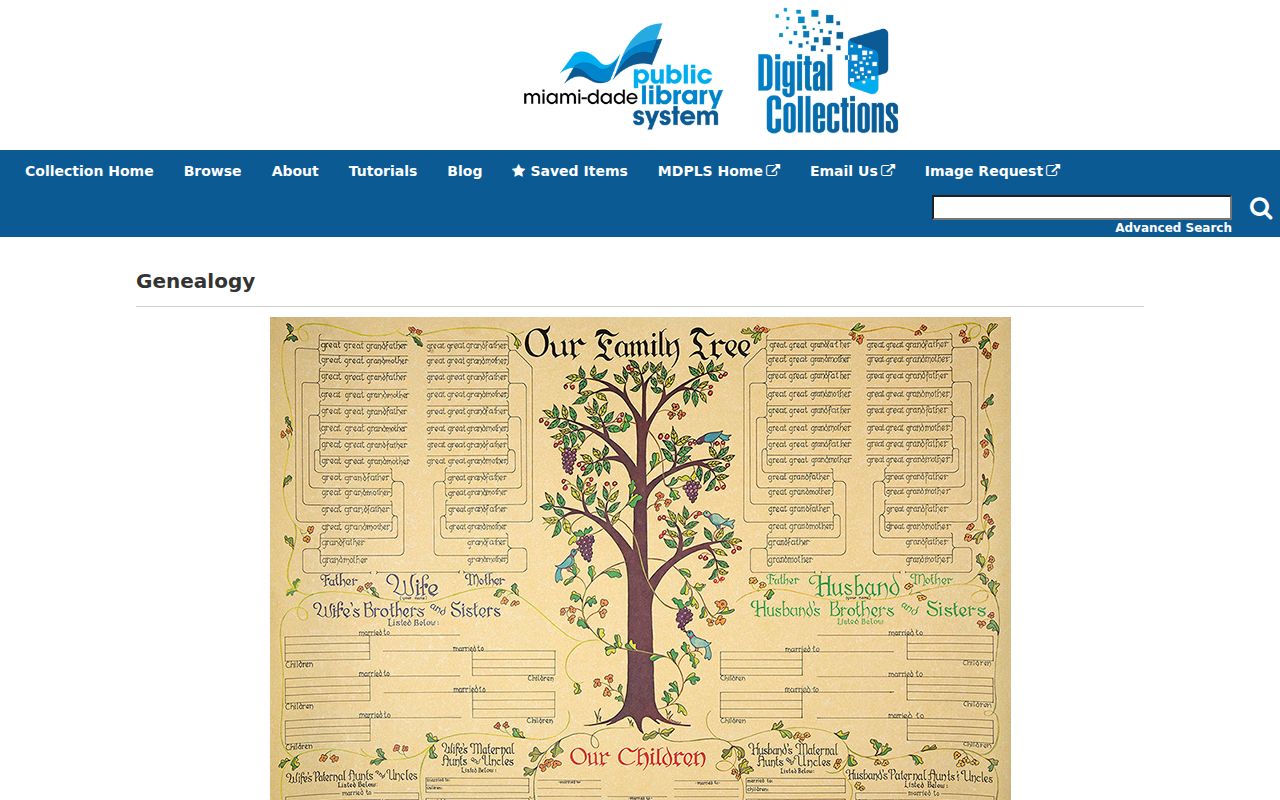
The MDPLS genealogy and local-history collection adds surname files, family newsletters, clippings, and family trees.
The State Library of Florida arranges its on-site directory collection by city and year, spanning the early 1900s to the present statewide. Contact the reference desk before travel to verify a Homestead holding. The Homestead Cybrarium is useful for local access questions, but no official online statement confirmed a dedicated Polk shelf there.
Homestead's Changing Directory Record
The surviving record changes medium as the town grows. This timeline explains why a search must move among newspapers, telephone lists, maps, directories, and government archives.
| 1912-1914 | South Florida Banner begins the digitized newspaper trail. |
|---|---|
| 1913 | Homestead incorporates; council minutes and reconstructed telephone data begin. |
| 1914 | A Sanborn fire-insurance map provides an address-history checkpoint. |
| 1927 | Polk publishes the first Homestead-area district directory. |
| 1938 | James W. English issues the Redland District News directory. |
| 1955 | Polk returns with the Directory of Homestead. |
Recent digitization and the city's online archives improve access to public documents. They do not fill the historical publication gaps or turn directory snapshots into a continuous resident roll.
Newspaper dates help between the printed landmarks. The Homestead Enterprise follows the early South Florida Banner, and the merger creating the Homestead Leader-Enterprise took effect on November 6, 1931. Search notices, advertisements, and obituaries around a directory date to distinguish two people who share initials or a surname.
Trace Families in Homestead Directories
Family history works best when a directory line is treated as a dated claim. Preserve the exact spelling, abbreviations, route, locality, spouse, and work detail. Then test those details against the nearest directory and census snapshots.
- Search the 1927 volume by surname variants, business, route, and address. Record the page and full printed line.
- Repeat in 1938 and 1955, comparing spouse, occupation, business, and locality rather than initials alone.
- Bridge gaps with the telephone years, deeds, tax records, newspapers, and available Sanborn maps.
- Pair 1927 with the 1930 census, 1938 with 1940, and 1955 with 1950. Use household relationships and enumeration geography to test the match.
- Search cemetery, obituary, school, church, and probate evidence when a person disappears from the sequence.
The 1950 census is the newest public population schedule under the 72-year rule; 1960 is due in 2032. A missing directory line may mean relocation, death, no telephone, non-enumeration, a publication gap, or failed OCR. Women may appear only as spouses or widows, and migrant agricultural workers may be missed. The evidence must be compared, not forced.